Where leaks really come from
Verizon's annual Data Breach Investigations Report (DBIR 2026, covering November 2024 to October 2025) finds that 31% of breaches start with a software vulnerability. According to the report, this is now the main way in, ahead of stolen passwords. Updates therefore matter as much as passwords, including on the machine that runs an AI.
On top of that come more mundane mistakes. A contractor keeps access they no longer need, or a database is left open on the internet. Sometimes an API key (the password one piece of software uses to connect to another) is left lying around in a shared file.
An AI installed on a poorly protected company server is therefore riskier than a well-configured professional online service.
Three sensitivity levels, before choosing the tool
An AI that is fine for follow-ups may be ruled out for contracts.
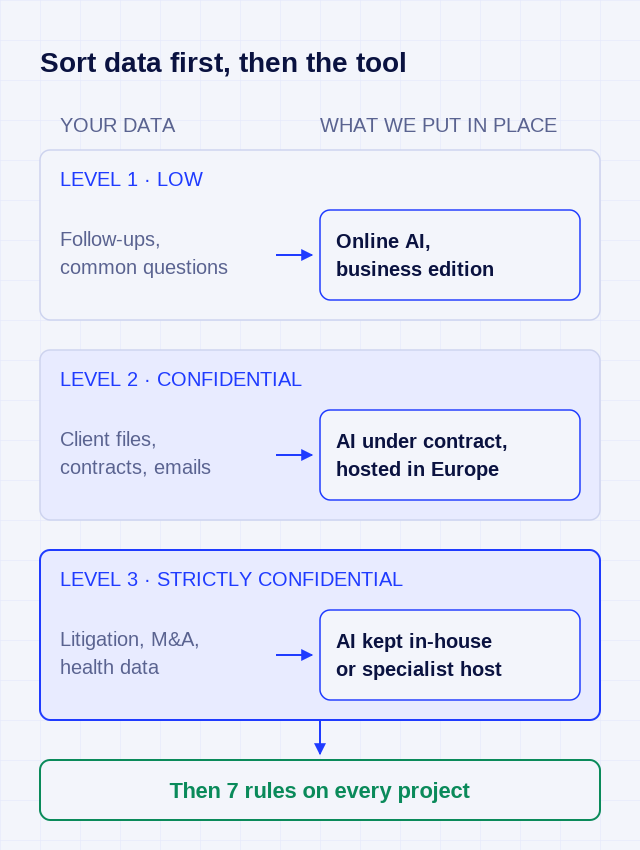
| Level | Examples of data | What we put in place |
|---|---|---|
| 1. Low sensitivity | Appointment booking, follow-ups, common questions, marketing content | An online AI, in its business edition |
| 2. Confidential | Client files, contracts, accounting records, emails | An AI provider bound by a data processing agreement (the contract that sets out what the provider may do with your data), hosting in Europe, the shortest possible retention, and names replaced before sending wherever possible |
| 3. Strictly confidential | Criminal matters, sensitive litigation, mergers and acquisitions, health | The AI stays inside the company, on a machine installed on your premises, or goes through a specialist host |
At level 3, we use an open model, meaning an AI model you can install yourself. It can summarise a contract or sort emails, but it is weaker at complex reasoning, costs more than a subscription and needs maintenance. Review and decisions stay with a person, and a security specialist always signs off the installation.
Two official benchmarks apply at this level, both French. SecNumCloud is the qualification that ANSSI, France's national cybersecurity agency, awards to cloud hosting providers that meet its standard (version 3.2 of 8 March 2022). For health data, HDS certification (health data hosting) is mandatory in France for hosting health data on behalf of a third party. According to the French Digital Health Agency, it is issued for three years and requires storage within the European Economic Area (EEA). Since 26 September 2026, the host must also inform its clients of the risk of access by authorities outside the EEA (Decree No. 2026-209).
The seven rules we apply to every project
When we build an AI agent for you, these rules apply from day one.
- Your data stays with you. We work inside your accounts, with dedicated access for our team that you can cut off at any time.
- Two-factor authentication everywhere. On top of the password, a code sent to your phone is required.
- Everyone accesses only what they need. Neither the agent nor the people have more rights than necessary.
- Encrypted data, tested backups. A backup only counts once you have successfully restored it.
- An access log. You know who looked at what, and when.
- Dummy files during the build. We test with made-up data, never with your customers' data.
- A separate installation for each client. Two companies' data never mix.
What to check with Claude and ChatGPT
The business editions and the API (the direct access used by software) do not follow the same rules as the personal editions. Here is what the official pages said when we checked them on 12 November 2026.
| Claude (Anthropic): Team, Enterprise and API plans | ChatGPT (OpenAI): Business, Enterprise and API plans | |
|---|---|---|
| Your data used for training | No by default, unless you send feedback (thumbs up or down) or give your consent | No by default, unless you give your consent |
| Retention period | API: deleted within 30 days. Team and Enterprise: kept until you delete it, then erased within 30 days; the period can be customised on Enterprise. Exceptions: 2 years for usage policy violations, 5 years for feedback | On Enterprise, the administrator sets the period, and deleted conversations are removed within 30 days |
| Zero retention (no record kept of your exchanges) | By contract, with Anthropic's approval: API, Claude Code via the API and Claude Code on the Enterprise plan. Not in the Team and Enterprise web, desktop and mobile apps | Available for eligible API customers |
| Data in Europe | No. Processing takes place in the United States or worldwide, and storage only in the United States | Storage in Europe available for new Enterprise workspaces, and processing in Europe, with zero retention, for new eligible API projects |
The legal framework: Mauritian law and the GDPR
In Mauritius, the Data Protection Act 2017 sets the rules. Section 31 requires a contract between the business that decides how the data is used and the one that processes it on its behalf, and section 14 requires both to register with the Data Protection Commissioner.
The European GDPR follows the same logic. When we process personal data on your behalf, we act as your processor within the meaning of the GDPR. The CNIL, France's data protection authority, points out that a precise written contract is then mandatory (Article 28) and that you remain responsible for your data. We sign this contract with you before we start.
This article is not legal advice. For your specific situation, consult the Data Protection Office in Mauritius, the CNIL in France, or a lawyer.
Where to start this week
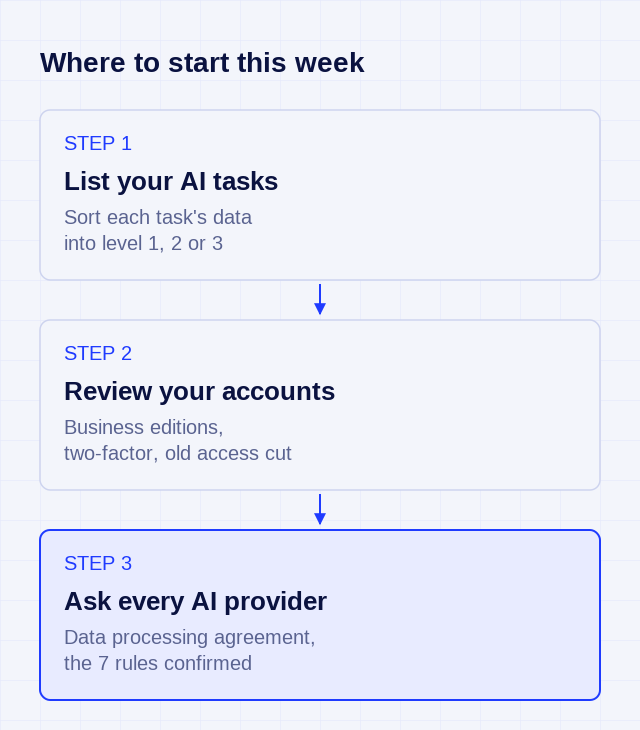
- List the tasks you want to hand over to AI and sort the data for each one into level 1, 2 or 3.
- Review your accounts. Check that you use business editions, that two-factor authentication is switched on and that former employees or contractors no longer have access.
- Ask every AI provider, including us, for their data processing agreement, the list of services they use themselves (model provider, host) and their confirmation of the seven rules above.
Frequently asked questions
Do ChatGPT and Claude use my company's data for training?
Not by default on their business plans or the API, unless you consent or, with Anthropic, send feedback with the thumbs up or down. We never use personal editions for client data.
Should we install an AI model in-house to protect our data?
Only for level 3 data. A poorly protected in-house installation is more exposed than a well-configured professional online service.
What contract should we sign with an AI provider?
A data processing agreement that sets out what the provider does with the data, for how long, with which security measures and which subcontractors. In Mauritius, this is required by section 31 of the Data Protection Act 2017; in Europe, by Article 28 of the GDPR, for which the CNIL publishes model clauses.
Can health data go through an AI?
Yes, at level 3, with a host certified for health data and an installation signed off by a specialist.
Sources
- Data Protection Office (Mauritius), Data Protection Act 2017, accessed on 12 November 2026
- CNIL, Data controller or processor: how to identify your role, accessed on 12 November 2026
- CNIL, Guide for processors, accessed on 12 November 2026
- Anthropic, Is my data used for model training?, accessed on 12 November 2026
- Anthropic, How long do you store my organization's data?, accessed on 12 November 2026
- Anthropic, Zero data retention agreement: products covered, accessed on 12 November 2026
- Claude Docs, Data residency, accessed on 12 November 2026
- OpenAI, Business data privacy, security, and compliance, accessed on 12 November 2026
- OpenAI, Introducing data residency in Europe, accessed on 12 November 2026
- ANSSI, SecNumCloud standard version 3.2, accessed on 12 November 2026
- French Digital Health Agency, Certification of health data hosts, accessed on 12 November 2026
- AP-HP, Decree No. 2026-209 of 24 March 2026 on health data hosting, accessed on 12 November 2026
- Verizon, 2026 Data Breach Investigations Report, accessed on 12 November 2026
Want us to look at your case?
A 30 to 40-minute call to see what is possible in your business, then a first written assessment, on us. Free, no commitment.
What we cover on the call
- Where you stand: your tools, your repetitive tasks, what takes the most time
- Your data and how confidential it is: what can go through an online AI, what must stay with you
- The first task to automate, the one that pays back fastest
- If you have an app in mind: who it is for and what its first version does
- What comes next: a clear quote before you commit
Ludovic Chapa, MAVERICKIA, AI agency. LinkedIn