What has changed, in plain terms
Claude is Anthropic's family of AI models. A model is the engine that reads your requests and writes the answers. Fable is the most powerful one open to all customers; Opus, Sonnet and Haiku cost less.
According to Anthropic's documentation, Fable 5.2 is designed for “demanding reasoning and long-running agentic work”. An AI agent is a program that carries out several actions on its own, such as looking up information and then filling in a spreadsheet. Anthropic mentions agent sessions lasting several hours, in-depth research in several steps, and analyses taken all the way to a finished deliverable (document, spreadsheet, presentation), which you review before sharing.
Prices are expressed in tokens, which are pieces of words: according to Anthropic, one million tokens is roughly 555,000 words. You pay for what you send to the model (input) and what it produces (output). Prices published by Anthropic, checked on 11 November 2026:
| Model | Input, per million tokens | Output, per million tokens | Speed |
|---|---|---|---|
| Fable 5.2 | $8 | $40 | Moderate |
| Fable 5.1 | $10 | $50 | |
| Opus 5.5 | $4 | $20 | Moderate |
| Sonnet 5.5 | $2 | $10 | Fast |
| Haiku 5.5 | from $0.10 | from $0.50 | Fastest |
Anthropic advises starting with Opus 5.5, moving up to Fable only if Opus is not enough, or moving down to Sonnet or Haiku for simple tasks.
In the Claude app, access depends on your plan (Claude Help Center, 11 November 2026):
| Plan | Access to Fable 5.2 |
|---|---|
| Free | Not available |
| Pro, and standard seats on the Team plan | Usage credits paid on top of the subscription |
| Max, Ultra, and premium seats on the Team plan | Included, up to 50% of weekly usage limits |
| Enterprise | Switched off at launch. From 16 November 2026, added automatically to roles that already have access to a Fable model, unless an administrator opts out |
| API (direct connection from software) | Prices in the table above |
One launch exception: in its 9 November 2026 announcement, Anthropic said that during that week, Fable was included up to 50% of weekly limits on the Pro plan and on standard Team seats. It was a temporary offer, after which the rule in the table applies again.
What it means for a business
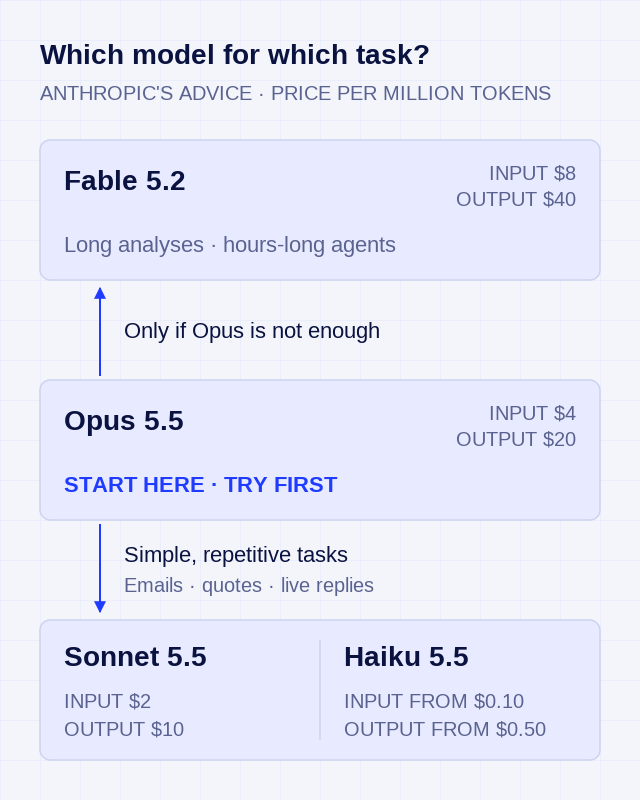
Sorting emails and following up on quotes. Nothing changes. These are short, repetitive tasks, for which Anthropic recommends Sonnet or Haiku: with Fable 5.2, each token costs four times as much as with Sonnet 5.5.
A file built from many documents. A tender response, a funding application, a comparison of supplier contracts: Fable 5.2 can read a very large volume of documents in one go and take the work through to the final document. Opus 5.5 can read just as much; the difference lies in the quality of reasoning when the file is complex. A person must always check the figures and reread the commitments before signing.
An agent that works for hours. This is what Fable 5.2 was designed for: regulatory monitoring, for example, or a multi-step supplier study, with the conclusions coming back to you. Anthropic notes that on long tasks, the model sometimes stops before the end and hands back a list of what remains to be done. Someone therefore needs to frame the task and check the result. We build this kind of project as AI agents, choosing the model task by task.
Live replies to customers. At its default setting, Fable 5.2 thinks before almost every answer, and this cannot be switched off. For a customer who is waiting, that is too slow and too expensive. A lighter model is a better fit, with a handover to a person for tricky cases.
What to check before using it
Your customers' data. Anthropic classes Fable 5.2 among its “Covered Models”, considered significantly more capable than previous generations. For these models, requests and responses are kept for at least 30 days, longer in the event of a security investigation or a legal obligation, and go through an automated safety check. Zero retention is not possible without Anthropic's express approval; according to the Help Center, it is not offered in Claude Enterprise organisations either.
On Amazon Bedrock or Google Cloud (the version managed by Google), the hosting provider processes the data, as a processor, under its own terms. The retention of at least 30 days applies there too.
The cost. Output costs five times as much as input, and the model's thinking makes answers longer. If simple requests cost too much, Anthropic recommends lowering the effort level, the setting that controls how deeply the model thinks. Non-urgent grouped processing (“batch”) is billed at half price; fast mode costs double, that is $16 and $80 per million tokens.
Known limits. Fable 5.2 reads text and images but only produces text. Its reliable knowledge stops at June 2026: for recent regulations or prices, give it up-to-date documents.
Where to start this week
- Write down the tasks you already use AI for and circle those where the result genuinely disappoints you: Fable 5.2 is only justified for those. Our free simulator gives you a rough idea of how much time they take.
- On one of these tasks, test Opus 5.5 first, on a document with no personal data. Only move to Fable 5.2 if the result is still not good enough. On the Pro plan, once the launch offer has ended, every test on Fable uses paid credits.
- Before any use with real data, check your plan in your account settings and have the 30-day retention approved by the person who handles data protection.
Frequently asked questions
Is Claude Fable 5.2 available for free?
No, not on the Free plan. On the Pro plan, outside the launch offer, Fable models run on usage credits paid on top of the subscription.
Should I choose Claude Fable 5.2 or Claude Opus 5.5?
Anthropic advises starting with Opus 5.5, which costs half as much. Fable 5.2 is only justified if Opus, at a higher effort level, is still not enough, usually for long analyses or agents that work for hours.
Can Claude Fable 5.2 be used in line with data protection law?
It depends on what you send it and on your safeguards. Exchanges are kept for at least 30 days, with no zero retention unless Anthropic expressly approves it or eligible customers use the Enterprise Frontier Safeguards arrangement. This must appear in your records of processing and in the information you give your customers.
What is Claude Mythos 5.2?
A model with the same capabilities and prices as Fable 5.2, reserved for organisations accepted into an Anthropic verification programme, for example in cybersecurity. It does not affect a typical small business.
Sources
- Anthropic, Claude Fable 5.2 and Claude Mythos 5.2, accessed on 11 November 2026
- Claude Docs, Claude Fable 5.2 (model overview), accessed on 11 November 2026
- Claude Docs, What's new in Claude Fable 5.2, accessed on 11 November 2026
- Claude Docs, API and data retention, accessed on 11 November 2026
- Claude Help Center, Covered Models, accessed on 11 November 2026
- Claude Help Center, Claude Fable models on your plan, accessed on 11 November 2026
Want us to look at your case?
A 30 to 40-minute call to see what is possible in your business, then a first written assessment, on us. Free, no commitment.
What we cover on the call
- Where you stand: your tools, your repetitive tasks, what takes the most time
- Your data and how confidential it is: what can go through an online AI, what must stay with you
- The first task to automate, the one that pays back fastest
- If you have an app in mind: who it is for and what its first version does
- What comes next: a clear quote before you commit
Ludovic Chapa, MAVERICKIA, AI agency. LinkedIn